
Blog
Machine Learning: Comprehensive insights and cutting-edge applications
The principles of machine learning, including an overview of the key differences between deep learning and machine learning, the types of machine learning techniques, and the machine learning pipeline. Current challenges and future trends in the field, and how machine learning impacts industries such as healthcare, finance, and e-commerce...

In the ever-evolving landscape of technology, machine learning (ML) stands out as a transformative force, revolutionizing industries and redefining the boundaries of what's possible. This blog aims to delve into the intricacies of machine learning, offering a nuanced perspective that transcends the conventional narratives often found online.
The Essence of Machine Learning:
At its core, machine learning is a subset of artificial intelligence (AI) that empowers systems to learn and improve from experience without being explicitly programmed. This paradigm shift from traditional programming to learning-based approaches is pivotal. In traditional programming, rules are explicitly defined by developers. Conversely, in machine learning, algorithms discern patterns from data and develop models that can make predictions or decisions based on new data.
Deep Learning vs Machine Learning: Key Differences
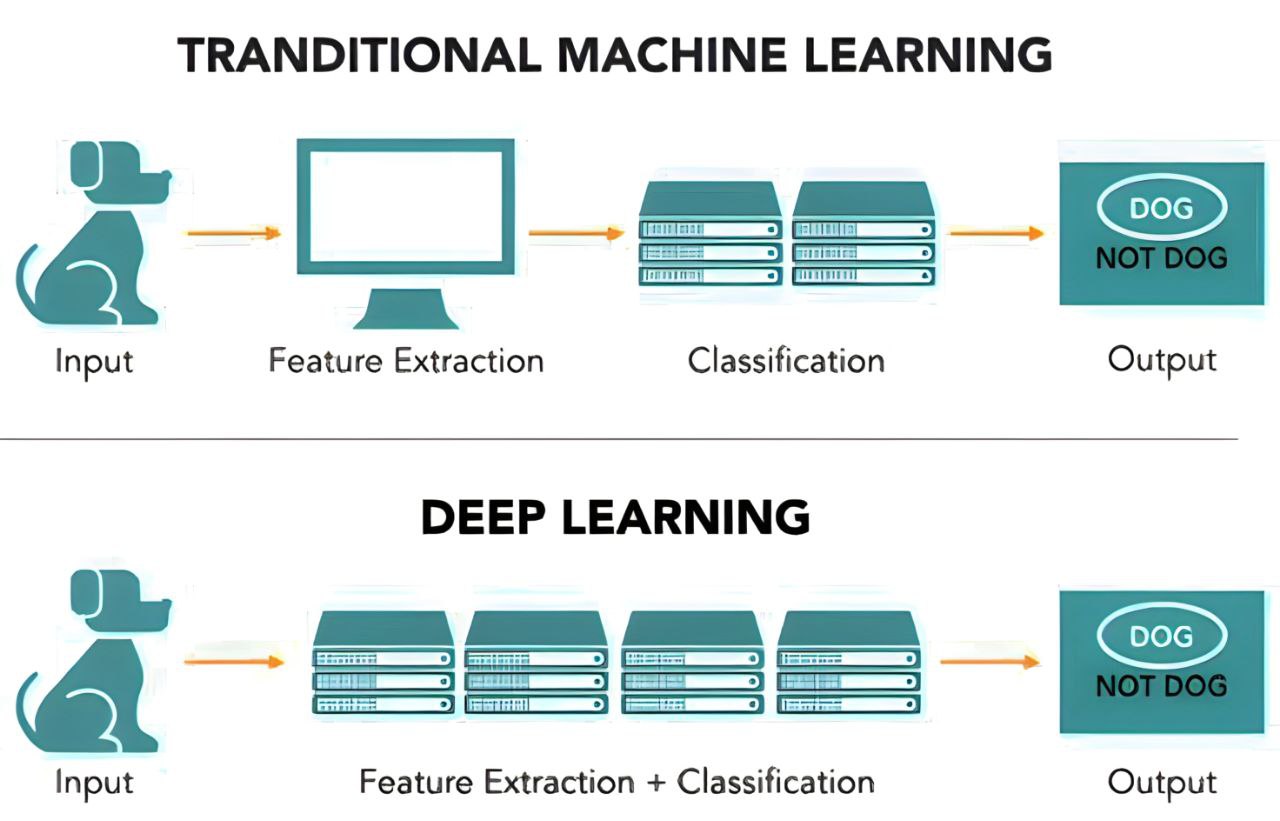
Machine learning and deep learning are closely related but differ in their approaches and capabilities. Machine learning is a broad field that involves algorithms learning from data to make predictions or decisions. It often requires manual feature extraction and data preprocessing. Deep learning, a specialized subset of machine learning, uses neural networks with multiple layers to automatically learn and represent data features. This allows deep learning to handle more complex tasks, such as image and speech recognition, with higher accuracy. In summary, deep learning is an advanced form of machine learning that excels at managing and learning from large datasets.
Types of Machine Learning:
- Supervised Learning: This approach involves training a model on a labeled dataset, which means that each training example is paired with an output label. Common algorithms include linear regression, support vector machines, and neural networks. Supervised learning is adept at tasks where historical data is abundant and accurately labeled, such as image classification and predictive analytics.
- Unsupervised Learning: Here, the model is given data without explicit instructions on what to do with it. The goal is to infer the natural structure present within a set of data points. Clustering and association are primary methods in unsupervised learning, with algorithms like K-means and hierarchical clustering being widely used. This type of learning is crucial for discovering hidden patterns or intrinsic structures in data.
- Reinforcement Learning: This type involves an agent that learns to make decisions by performing actions in an environment to achieve maximum cumulative reward. Unlike supervised learning, reinforcement learning does not require labeled input/output pairs. Instead, it relies on the exploration of the environment. Notable applications include AlphaGo and autonomous driving.
The Machine Learning Pipeline
Building a successful machine learning model is not just about selecting the right algorithm. It involves a well-orchestrated pipeline that includes:
- Data Collection and Preprocessing: The quality of data directly influences the model's performance. This stage involves gathering relevant data, cleaning it, handling missing values, and performing feature engineering to transform raw data into a format suitable for modeling.
- Model Selection and Training: Choosing the right algorithm and tuning hyperparameters are critical. This phase involves splitting the data into training and validation sets, training the model, and optimizing it to improve performance.
- Evaluation and Validation: It's crucial to assess the model's performance using metrics like accuracy, precision, recall, and F1-score. Cross-validation techniques help ensure the model generalizes well to unseen data.
- Deployment and Monitoring: Once validated, the model is deployed to a production environment where it can start making predictions. Continuous monitoring is essential to ensure the model remains accurate over time, especially as new data becomes available.
Challenges and Future Directions
While the potential of machine learning is immense, several challenges remain. These include:
- Data Privacy: Ensuring the privacy and security of data used for training models is paramount. Techniques like federated learning and differential privacy are emerging to address these concerns.
- Bias and Fairness: Machine learning models can inadvertently perpetuate or even amplify societal biases present in training data. Developing fair and unbiased models is an ongoing area of research.
- Explainability: As models become more complex, especially with deep learning, understanding how decisions are made becomes challenging. Explainable AI (XAI) seeks to make the decision-making process of models more transparent and understandable.
Looking ahead, the integration of quantum computing with machine learning, advancements in natural language processing, and the development of more sophisticated algorithms promise to propel the field to new heights.
Transformative Applications of Machine Learning Across Industries:
Machine learning has a wide array of applications that span across various industries. In healthcare, it is used for predictive analytics to foresee patient outcomes and for personalized medicine to tailor treatments to individual patients. In finance, machine learning algorithms detect fraudulent transactions and optimize investment strategies. In the realm of e-commerce, recommendation systems suggest products to customers based on their browsing and purchase history. Additionally, in autonomous driving, machine learning enables vehicles to interpret sensor data, recognize objects, and make real-time driving decisions, paving the way for safer and more efficient transportation systems. These examples underscore the transformative impact of machine learning on both everyday life and specialized fields.
Machine learning is a dynamic and rapidly evolving field with the potential to transform every aspect of our lives. By understanding its foundational principles, methodologies, and the challenges that lie ahead, we can better harness its power to drive innovation and solve complex problems. As we continue to explore the depths of machine learning, one thing remains clear: the future is intelligent, and machine learning is at the heart of this transformation.
 Sales Question
